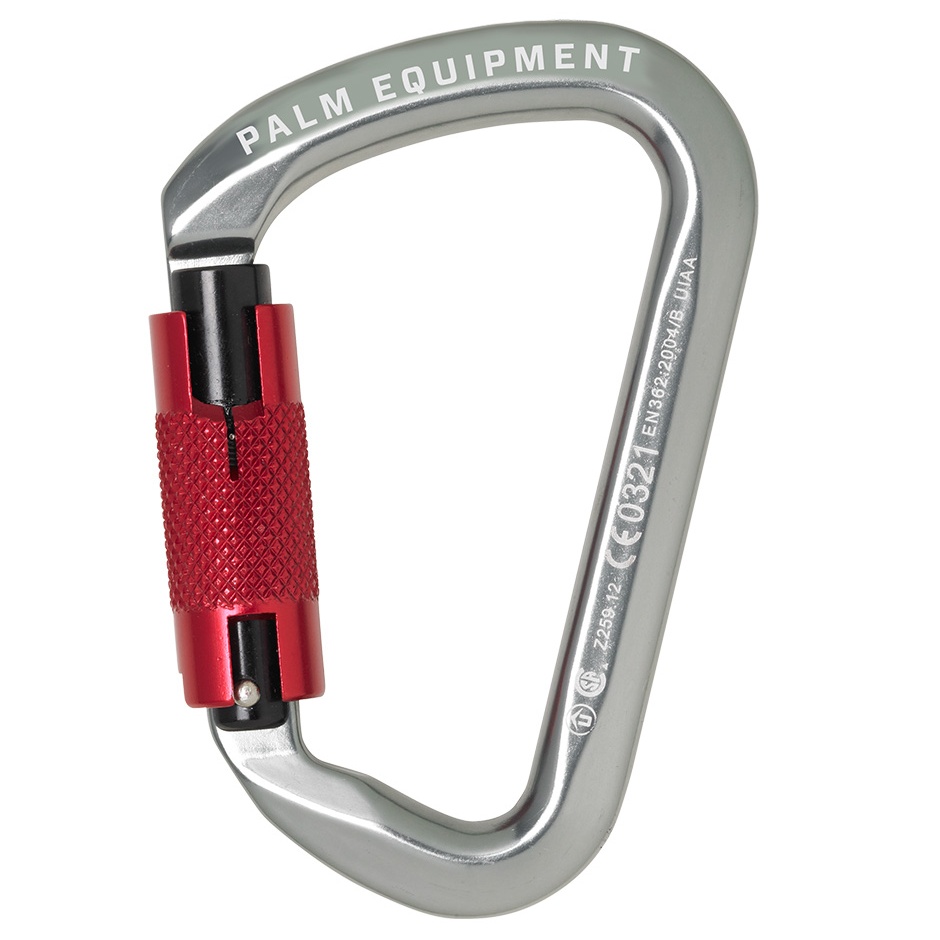
The Palm Autolock Karabiner is the standard rescue-kit karabiner for whitewater and touring paddlers who want screwgate-level security without stopping to screw a gate shut mid-rescue. Built from anodised aluminium and rated to 28kN on the major axis, it's designed to sit on a throwline, tow belt or flip line and be trusted the moment it's needed — not fiddled with under pressure.
Autolock vs Screwgate vs Wiregate — Why Autolock
An autolock karabiner locks the gate pin automatically as soon as it closes, giving the same closed-gate security as a screwgate karabiner without needing to twist a locking sleeve shut by hand. That matters in a real rescue: fumbling with a screwgate in cold water, with gloves on, costs time. A wiregate karabiner is lighter again but has no locking gate at all — independent paddlesport rescue guidance specifically warns against non-locking karabiners for rescue kit, since an open gate can snag or release under load during a swim. Autolock sits between the two: locked by default, no manual step required.
What the 28kN Rating Actually Means
The Palm Autolock Karabiner is rated 28kN on the major axis, 8kN on the minor axis, and 8kN with the gate open. A kilonewton (kN) is a unit of force — roughly 225lbs — and these figures are the load each orientation can withstand before the metal fails, not a working recommendation. Paddlesport rescue guidance generally puts 25kN as a sensible minimum for a rescue karabiner and 31kN as a more comfortable margin; at 28kN, this one sits above the minimum and below that higher margin, making it a genuinely rescue-grade choice without overclaiming best-in-class. The gap between the major-axis figure and the much lower minor-axis and open-gate figures is also why correct orientation and gate closure matter every time it's clipped in — loaded side-on or through an open gate, it's far weaker.
Built for Water Rescue, Not Climbing Protection
This karabiner is certified to EN362:2004/B and UIAA approved — first-party safety certification for connector hardware used in rescue and towing applications, not a claim about suitability for lead climbing or fall-arrest use, which sits under a different standard (EN 12275). It's designed and rated as water-rescue and towing equipment: on a throwline like the Palm Bolt 20m or Palm Pro Throwline, on a tow belt, or as part of a flip line on a whitewater boat such as the Silverbirch Agent 88.
Specs & Build
Anodised aluminium construction, 97g, with a 24mm gate opening — light enough to carry two or three without adding meaningful bulk to a kit bag, which matters for a coach or instructor buying in multiples. Certified EN362:2004/B and UIAA approved throughout.
Who Needs One (and How Many)
If you're building or restocking a whitewater or touring rescue kit — solo, tandem, or as a coach equipping a club kit bag — this is the standard karabiner to reach for. Paddlesport rescue guidance generally recommends at least two manual-locking karabiners per person plus one auto-locking karabiner on a flip line, so most paddlers will want more than one. It's not a substitute for climbing-rated hardware, and it won't suit anyone after the lightest possible non-locking option for non-rescue use — the Palm Wire Gate Karabiner covers that case instead.
Full delivery information and warranty terms apply as with any order from The Boathouse. Browse the rest of the Rescue Kit range — including the Palm Screw Gate and Palm Side Swing HMS Autolock — to build a complete rescue kit in one order.
Frequently Asked Questions
What does the kN rating on a karabiner mean?
kN stands for kilonewton, a unit of force equal to roughly 225lbs. It's the load a karabiner can withstand before it fails — the Palm Autolock Karabiner is rated 28kN on its major axis (highest strength, gate closed and correctly loaded) and 8kN on both the minor axis and open-gate, which is why correct orientation matters in a rescue.
What's the difference between an autolock and a screwgate karabiner?
A screwgate karabiner needs its sleeve manually twisted shut to lock; an autolock karabiner like this one locks the gate automatically the moment it closes, giving the same closed-gate security without that extra step — useful when you need to clip in fast, in cold water, under pressure. The Boathouse also stocks a Palm Screw Gate Karabiner and Palm Side Swing HMS Autolock if you're building a mixed kit.
Why shouldn't I use a wiregate karabiner for kayak rescue kit?
A wiregate karabiner has no locking gate at all, so it can snag open or release under load during a swim — paddlesport safety guidance specifically advises against non-locking karabiners for rescue use for this reason. A locking type, autolock or screwgate, is the safer choice for a rescue kit.
How many karabiners should be in a whitewater rescue kit?
General paddlesport rescue guidance recommends at least two manual-locking karabiners per person, plus one auto-locking karabiner on a flip line, so most kits need more than one. Coaches and clubs equipping multiple paddlers typically buy in multiples for exactly this reason.
Is the Palm Autolock Karabiner suitable for climbing?
It's designed and rated for water rescue and towing use (EN362:2004/B, UIAA approved), not marketed or certified against the climbing protection standard (EN 12275). For climbing, look for hardware specifically rated to that standard rather